








10,000+ Learners Certified
Certified MCP Security Expert (CMCPSE)TM
Secure MCP before attackers weaponize it. The Model Context Protocol is now the backbone of agentic AI, and attackers have noticed. Real-world exploits are already in the wild: tool poisoning, supply chain compromises with CVSSv3 scores of 9.6, and cross-server privilege escalation affecting servers with hundreds of thousands of downloads.
Become a Certified MCP Security Expert within 60 days.
 Self-paced learning
 Browser-based lab access
 24/7 Instructor support
Self-paced learning mode
Browser-based lab access
24/7 Instructor support
Self-paced learning mode
Browser-based lab access
24/7 Instructor support
Trusted by top companies across industries, empowering thousands of professionals worldwide. Join the ranks of security leaders
Course Chapters
“Here’s exactly what you’ll master in 6 hands-on chapters:”
Course Pre-requisites
- Course participants should have knowledge of running basic Linux commands like ls, cd, mkdir, etc.,
- Familiarity with any scripting language like Python, Golang, or ruby helps. However, it’s not a necessity.
Chapter 1: Introduction To MCP And The Agentic Ecosystem
- About the course, syllabus, and how to approach it
- About the CMSP Certification and how to approach it
- Course Lab Environment
- Lifetime course support (Mattermost)
- An overview of MCP Security
- What is MCP?
- The origin and history of MCP
- The problem MCP was designed to solve
- MCP vs REST APIs vs function calling vs other integration patterns
- The MCP ecosystem today: adoption, registries, and tooling
- MCP Architecture Deep Dive
- The three-tier model: Hosts, Clients, and Servers
- The three primitives: Tools, Resources, and Prompts
- Transport mechanisms: stdio, SSE, and HTTP with SSE
- The JSON-RPC 2.0 protocol layer
- MCP lifecycle: initialization, capability negotiation, and message exchange
- Agentic AI Ecosystem
- What are AI agents?
- Single-agent vs multi-agent systems
- Agentic workflows and orchestration patterns
- Where MCP fits in the agentic stack
- Popular hosts and frameworks using MCP (Claude Desktop, Cursor, Continue, and others)
- The rapid growth of third-party MCP server registries
- MCP Security – A First Look
- Why MCP is a high-value target for attackers
- The unique security challenges that agentic systems introduce
- A high-level map of the MCP threat landscape
- What this course will cover and how chapters connect
- Hands-on Exercise:
- Learn how to use our browser-based lab environment
- Install and configure a Python-based MCP server from scratch
- Connect to a local MCP server
- Observing MCP protocol-level communication
- Building an MCP server with tools and resources
Chapter 2: Understanding And Attacking MCP Servers
- Introduction to the MCP Attack Surface
- What attackers look for in an MCP deployment
- Attack surface mapping for MCP environments
- Threat actor profiles and motivations targeting MC
- Attack Tactics and Techniques
- MITRE ATT&CK relevance to MCP environments
- MITRE ATLAS for agentic AI systems
- Reconnaissance of MCP environments
- Resource development tactic
- Initial access tactic
- Execution tactic
- Persistence tactic
- Privilege escalation tactic
- Defense evasion tactic
- Exfiltration tactic
- Impact tactic
- MCP-Specific Attack Primitives
- Tool Poisoning attacks
- What tool poisoning is and why it works
- Hiding malicious instructions in tool descriptions
- Tool schema manipulation
- Prompt Injection via Tool Responses
- How tool responses become injection vectors
- Direct vs indirect prompt injection through MCP
- Server Impersonation and Typosquatting
- Registering malicious MCP servers with similar names
- Man-in-the-middle via fake MCP endpoints
- Rug-Pull Attacks
- Changing server behavior post-approval by the user or host
- Dynamic tool definition manipulation
- Cross-Server Privilege Escalation
- Exploiting trust between MCP servers in multi-agent pipelines
- Lateral movement through chained tool calls
- Confused Deputy Attacks
- Tricking a privileged MCP server into acting on behalf of an attacker
- Resource Hijacking
- Accessing resources beyond intended scope
- Sensitive data exposure through misconfigured resource endpoints
- Tool Poisoning attacks
- MCP Vulnerability Classes
- Unauthenticated MCP endpoints
- Insecure transport configurations
- Excessive tool permissions
- Insufficient input and output validation
- Insecure prompt handling in tool schemas
- Sensitive information leakage via error messages
- Insecure defaults in popular MCP SDKs
- Real-World MCP Attack Scenarios
- Case studies of MCP exploitation in the wild
- Attack chaining across multi-server agentic pipelines
- Multi-agent attack propagation patterns
- Hands-on Exercises:
- MCP server reconnaissance and endpoint enumeration
- Perform a tool poisoning attack on a vulnerable MCP server
- Exploit prompt injection via crafted tool responses
- Execute a server impersonation attack
- Demonstrate a rug-pull attack by modifying tool behavior post-approval
- Cross-server privilege escalation in a multi-agent pipeline
- Confused deputy attack exercise
- Exploit an unauthenticated MCP endpoint to exfiltrate data
- Combine multiple attack primitives in a single kill chain
Chapter 3: Threat Modeling MCP Architectures
- Introduction to Threat Modeling
- What is threat modeling?
- Why threat model MCP systems specifically?
- Threat modeling challenges in agentic AI environments
- Threat modeling benefits for MCP practitioners
- Threat Modeling Fundamentals
- What are assets in an MCP context?
- Weaknesses vs vulnerabilities in MCP
- Risk management stages
- The STRIDE methodology
- Diagramming MCP Architectures
- Introduction to Data Flow Diagrams (DFDs)
- DFD components in the MCP context
- Diagramming a simple single-server MCP architecture
- Diagramming a complex multi-server agentic pipeline
- Identifying and drawing trust boundaries between hosts, clients, and servers
- Applying STRIDE to MCP
- MCP and Agentic Threat Libraries
- MITRE ATLAS for agentic systems
- OWASP LLM Top 10 relevance to MCP
- Emerging MCP-specific threat taxonomies
- AI Incident Database
- AI Risk Repository
- AI Threat Map
- Rating and Managing Risks
- Risk rating methodology for MCP-specific threats
- Prioritizing findings from a threat model
- Risk management strategies and mitigations
- Communicating threat model outputs to stakeholders
- Hands-on Exercises:
- Build a data flow diagram for a single-server MCP architecture
- Build a data flow diagram for a multi-server agentic pipeline
- Apply STRIDE to a provided MCP architecture and document findings
- Risk rating exercise on STRIDE findings
- Threat modeling with IriusRisk for an MCP deployment
Chapter 4: Defending And Hardening MCP Servers
- Introduction to MCP Defense
- Defense-in-depth principles applied to MCP
- Secure by design for MCP servers
- Mapping defenses to the attack surface
- Authentication and Authorization
- MCP authentication mechanisms overview
- OAuth 2.0 for MCP over HTTP transport
- Token-based auth for stdio and SSE transports
- Implementing role-based access control for tools and resources
- Principle of least privilege in MCP contexts
- Client identity verification
- Secure Tool and Resource Design
- Least-privilege tool design principles
- Scoping tool permissions to minimum required access
- Input validation for tool parameters
- Output sanitization to prevent injection propagation
- Resource access controls and scoping
- Avoiding information disclosure in descriptions
- Transport Security
- Securing stdio transport
- Implementing TLS for SSE and HTTP transports
- Certificate validation and pinning
- Secure configuration of MCP endpoints
- Network-level controls for MCP server exposure
- Secrets Management
- Avoiding credentials and secrets in tool schemas
- Environment variable security for MCP servers
- Integrating MCP servers with secrets vaults (HashiCorp Vault)
- Rotating secrets in agentic environments
- Logging, Monitoring, and Detection
- What to log in MCP environments
- Logging tool invocations with full context
- Detecting anomalous and abusive tool usage patterns
- Monitoring agentic pipelines for suspicious behavior
- Alerting on indicators of MCP-based attacks
- Audit trails and non-repudiation for tool calls
- Secure MCP Server Development Practices
- Secure coding practices for MCP server implementation
- Safe dependency management
- Error handling to prevent information disclosure
- Security testing during the development process
- Code review checklist for MCP servers
- Hands-on Exercises:
- Implement OAuth 2.0 authentication on an MCP server
- Configure least-privilege tool permissions on a running MCP server
- Set up TLS for an MCP server with HTTP/SSE transport
- Implement and validate tool input sanitization
- Integrate a secrets vault with an MCP server
- Configure comprehensive logging for tool invocations
- Detect and alert on anomalous MCP tool usage using a SIEM
- Harden a deliberately misconfigured MCP server end to end
Chapter 5: Integrating DevSecOps Practices For MCP Security
- Introduction to DevSecOps for MCP
- DevSecOps and DevOps principles in the agentic context
- The MCP security development lifecycle
- Shifting security left for MCP server development
- The role of automation in MCP security
- Static Analysis of MCP Server Code
- SAST tools applicable to MCP server codebases
- Identifying vulnerabilities in tool and resource implementations
- Scanning for hardcoded secrets in MCP server code
- Code review practices and checklists specific to MCP
- Dynamic Analysis and Runtime Testing
- DAST approaches for MCP servers over HTTP/SSE transport
- Fuzzing MCP tool inputs for unexpected behavior
- Runtime security testing of agentic pipelines
- Penetration testing methodology for MCP environments
- Scoping an MCP assessment
- Reconnaissance and enumeration
- Exploitation and chaining
- Reporting findings professionally
- CI/CD Pipeline Integration for MCP Security
- Embedding MCP-specific security checks into pipelines
- Automated vulnerability scanning for MCP server dependencies
- Policy as code for MCP deployments
- Security gates, break-build policies, and approval workflows
- Cases of pipeline-based attacks on AI and MCP deployments
- AI Firewalls and Runtime Protection
- AI firewall concepts for agentic workloads
- Protecting MCP tool invocations at runtime
- Detecting prompt injection at the gateway level
- Rate limiting and abuse prevention for MCP endpoints
- Guardrails for tool output before it reaches the LLM
- Hands-on Exercises:
- Run SAST scanning against a deliberately vulnerable MCP server codebase
- Fuzz MCP tool inputs using a Python-based fuzzing framework
- Set up a CI/CD security pipeline with automated MCP security checks
- Execute a poisoned pipeline attack targeting an MCP deployment
- Deploy and configure an AI firewall for an MCP server
Chapter 6: Supply Chain Security And Governance Of MCP Servers
- Overview of the MCP Supply Chain
- Components and stages of the MCP supply chain
- Third-party MCP package registries and their risks
- Attack vectors introduced by the MCP supply chain
- Real-world supply chain incidents relevant to MCP
- Vetting and Managing Third-Party MCP Servers
- Creating a vetting process for third-party MCP packages
- Dependency analysis and risk scoring
- Scanning MCP server packages for known vulnerabilities
- Dependency pinning and version locking for MCP servers
- Mitigating dependency confusion in MCP ecosystems
- Automating the vetting of third-party MCP components
- Transparency and Integrity in the MCP Supply Chain
- Generating Software Bill of Materials (SBOMs) for MCP servers
- Provenance and attestations for MCP server builds
- MCP server signing: concepts and implementation
- Model Cards and MLBOMs in agentic contexts
- Verifying integrity of third-party MCP servers before deployment
- Supply Chain Security Frameworks
- SLSA (Supply chain Levels for Software Artifacts) for MCP builds
- Software Component Verification Standard (SCVS)
- OpenSSF best practices for MCP server maintainers
- AI Governance Frameworks
- Standards, guidelines, and frameworks applicable to MCP
- NIST AI Risk Management Framework (RMF)
- ISO/IEC 42001
- Other emerging standards and guidelines
- Applying governance frameworks to MCP deployments specifically
- Standards, guidelines, and frameworks applicable to MCP
- Compliance and Regulation
- EU AI Act implications for MCP server operators
- US AI legislation and executive orders
- Building an organizational compliance posture for MCP
- Compliance checklists for MCP deployment
- Emerging Threats in MCP
- Agentic worms propagating autonomously through MCP chains
- Shadow MCP servers in enterprise environments
- Malicious MCP registries and package poisoning
- AI-assisted exploitation targeting MCP deployments
- Hands-on Exercises:
- Backdoor injection into a simulated third-party MCP server package
- Generate an SBOM for an MCP server and analyze its components
- Sign an MCP server build and verify its integrity on deployment
- Create provenance attestations for an MCP server CI/CD pipeline
MCP Security Certification Process
- After completing the course, you can schedule the CMSE exam on your preferred date.
- Process of achieving Practical DevSecOps CMSE Certification can be found here.
Senior Security Engineer (MCP Security)
AI Security Architect [MCP & Agentic AI]
Principal Cybersecurity Engineer (MCP Integration)
Application Security Lead [Model Context Protocol]
Become an MCP Security Expert in 60 Days
Proof > Promises. Certifications Hiring Managers Trust
Career Outlook
What can I do with the MCP Security Certification?
AI-powered and agentic systems are now the default infrastructure for modern organizations. This certification gives you practical skills to secure MCP architectures, LLM pipelines, and agentic AI systems. It puts you in position for high-demand roles where traditional security knowledge alone won’t cut it.
Built for People Who Secure AI Systems for a Living
The roles that can’t afford to get this wrong
Senior Security Engineer (MCP Security)
Stop MCP server breaches by enforcing authentication and authorization controls, detecting tool poisoning and prompt injection at runtime, and hardening agentic pipelines before attackers exploit exposed tool interfaces.
AI Security Architect [MCP & Agentic AI]
Eliminate design-level risk in agentic systems by threat modeling MCP architectures with STRIDE and MITRE ATLAS, enforcing zero-trust principles across agent-to-tool communication, and building security into AI infrastructure from the ground up.
Principal Cybersecurity Engineer (MCP Integration)
Prevent supply chain compromise by generating SBOMs, enforcing code signing and provenance attestations, applying SLSA frameworks, and automating security gates across CI/CD pipelines before agentic workloads reach production.
Application Security Lead [Model Context Protocol]
Remove vulnerabilities before deployment by embedding SAST, SCA, and DAST in MCP development pipelines, blocking malicious tool registrations at intake, and securing API surfaces and dependencies across agentic application stacks.
85%
of enterprises are actively adopting AI, yet fewer than 1 in 4 have dedicated AI security controls in place. The skill shortage is real. The talent gap is your opportunity.
$165k+
Average salary for AI Security Engineers in the US. Professionals with hands-on AI and ML security expertise command premium compensation across industries deploying agentic systems.
Understanding the above numbers
These figures reflect industry-wide trends from Gartner, IBM Security, ZipRecruiter and the Bureau of Labor Statistics and market research. Actual salaries depend on your experience, location, industry, and how effectively you apply your skills. We provide the training. The results are yours to build.
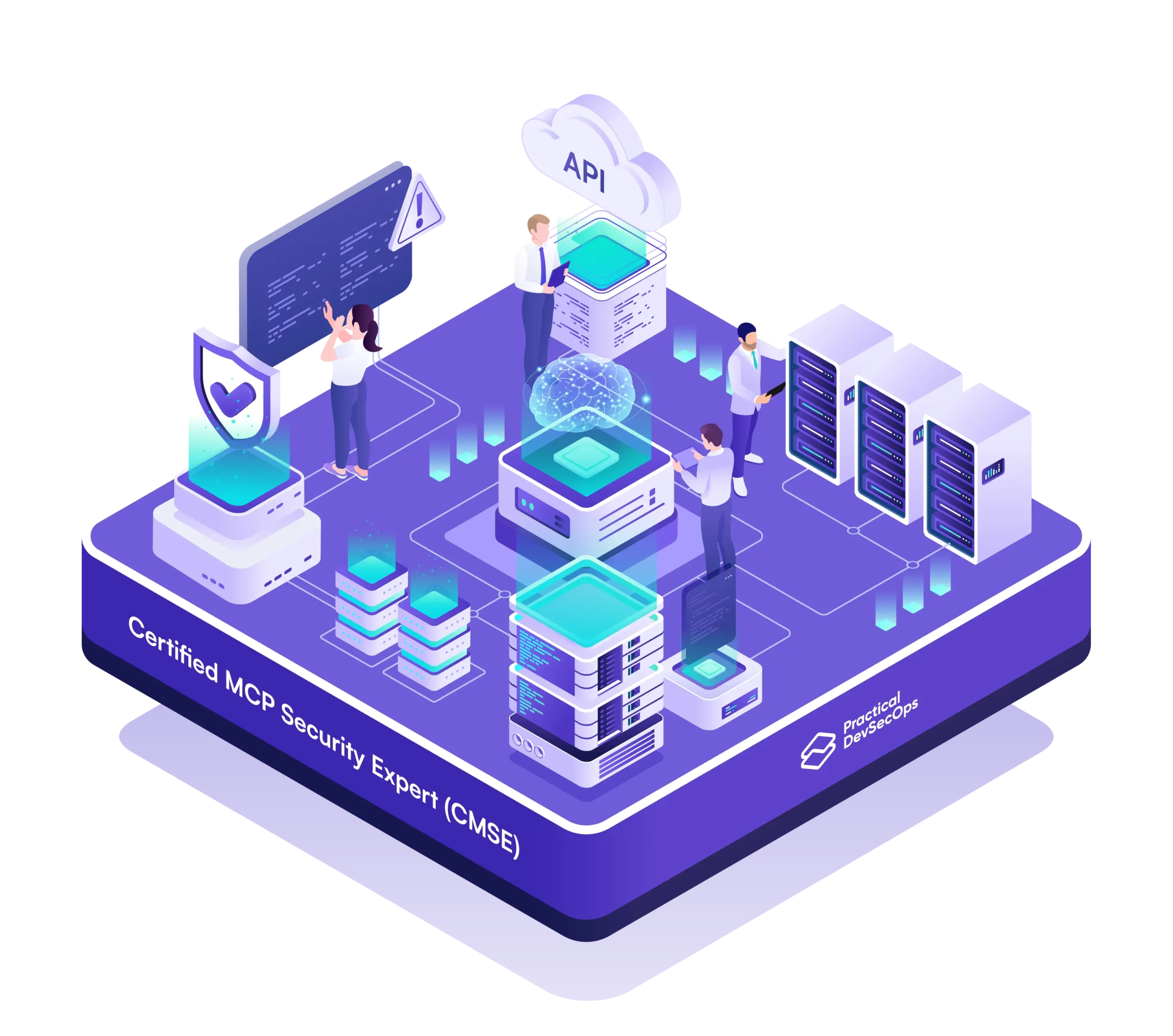
Certified MCP Security Expert?
Hands-on MCP Security
- Identify and exploit MCP server vulnerabilities
- Tool poisoning, prompt injection, server impersonation and rug-pull attacks
- Real-world agentic security breach simulations
Attacking MCP Servers
- Attack surface mapping using MITRE ATLAS frameworks
- Understand and exploit MCP-specific attack primitives
- Simulate real-world compromises of agentic AI systems
Threat Modeling MCP Architectures
- Apply STRIDE methodology to agentic systems
- Build data flow diagrams for MCP-based architectures
- Conduct risk assessments for AI-driven environments
- Map trust boundaries and privilege levels across multi-agent MCP systems
- Use MITRE ATLAS to identify and categorize AI-specific attack patterns
Defending & Hardening MCP Servers
- Implement authentication, authorization and secure design principles
- Apply transport security and secrets management best practices
- Set up monitoring and logging for continuous security posture improvement
DevSecOps Integration
- Embed static and dynamic analysis into CI/CD pipelines
- Deploy AI firewalls and automated security testing
- Enforce security policies before agentic workloads reach production
Supply Chain Security
- Generate SBOMs and implement code signing
- Apply provenance attestations and SLSA frameworks
- Ensure governance and compliance across the MCP supply chain
We have provided training and presented at numerous industry events.




Hear from our learners
We’re proud to be working with these incredible Security Engineers, and thankful for their feedback, suggestions, and support.












Frequently asked questions
What are the prerequisites required before enrolling in the Certified MCP Security Expert Course?
Basic Linux command knowledge is essential before starting this course. While not mandatory, having experience with networking concepts and general security fundamentals will give you an advantage. Familiarity with Python or scripting, AI systems, APIs, or OWASP Top 10 vulnerabilities is also beneficial.
What's included in the Certified MCP Security Expert course package?
Your enrollment includes 3-year access to all video content, 60 days of hands-on browser-based labs, a comprehensive PDF manual, 40+ guided exercises, 24/7 support and one certification exam attempt.
Does the Certified MCP Security Expert Course Start Immediately after enrollment?
No, the course doesn’t begin automatically after purchase. Instead, you’ll have the flexibility to choose your preferred start date, and your course access will be activated from your selected date.
E.g., you can start 2 to 3 months later as well.
Does the Certified MCP Security Expert come with CPE points?
Yes, upon completion of the MCP Security Expert course, you’ll earn 40 CPE points.
What is the Exam Format for the Certified MCP Security Expert?
The exam follows a practical format, where you’ll tackle 5 real-world challenges within a 6-hour window. You’ll then have an additional 24 hours to prepare and submit your detailed report for evaluation. For more information, visit this link.
Should I go to an exam center, or is the exam online?
No, it is an online exam. You can take the exam from the comfort of your home or office.
How long is the Certified MCP Security Expert certification valid?
The MCP Security Expert certification is a lifetime credential that never expires. Once you earn it, it remains valid throughout your entire career with no renewal requirements.
How Much More Can You Earn with the Certified MCP Security Expert Course?
The numbers tell the story. Regular Security Engineers make around $110,000, but with CMSE certification, you’re looking at $130,000 to $165,000, with top experts pulling in $175,000+. That’s a 15-25% salary increase just for knowing how to secure AI systems and MCP architectures.
Here’s the reality: every company is rushing to adopt AI agents and LLM-powered tools, but almost nobody knows how to secure them properly. It’s still emerging technology, and while everyone is deploying agentic systems left and right, the people who can actually protect these environments are incredibly rare. Without certification, you’re stuck around $80,000 to $100,000 watching others get promoted.
The AI security market is projected to reach $60.6 billion by 2032, and companies are under pressure. They’ve moved quickly to adopt AI but have no idea how to handle tool poisoning, prompt injection, or supply chain risks in agentic systems. When you walk in with CMSE certification, you’re not just another security engineer. You’re the person who can actually secure their entire AI stack.
CMSE isn’t just a piece of paper either. It’s comprehensive, hands-on training that teaches you real MCP security, not theory, but actual skills you’ll use every day. Security engineers, penetration testers, red teamers, and DevOps professionals are all getting certified because they see what’s coming: if you can’t secure AI systems, you’ll be left behind.
Why choose the Certified MCP Security Expert course from Practical DevSecOps?
Unlike theoretical courses, this vendor-neutral certification provides hands-on experience tackling real-world MCP security challenges. With 24/7 support via Mattermost and browser-based labs, this course will help you become job ready to secure AI and agentic systems for large enterprises.
What you’ll learn:
- Attack and defend MCP servers through realistic scenarios and implement proper countermeasures.
- Secure agentic AI systems with proper authentication, authorization, and hardening mechanisms.
- Apply threat modeling using STRIDE and MITRE ATLAS to identify risks in MCP architectures.
- Protect sensitive data with secrets management and detect threats through runtime monitoring and audit logs.
Unmatched practical focus
70% hands-on labs for mastering real-world scenarios.
Expert-crafted curriculum
Get real-world insights from experienced security experts.
Practical exam
Take a 6-hour examination to show what you have learned.
24/7 expert support
Future-Proof Your Career with MCP Security Training
Unlock your potential with MCP Security Certification! Our Certified MCP Security Expert (CMSE) Course equips you with job-ready skills. Conquer the 6-hour exam with confidence and open doors to exciting opportunities and challenges.